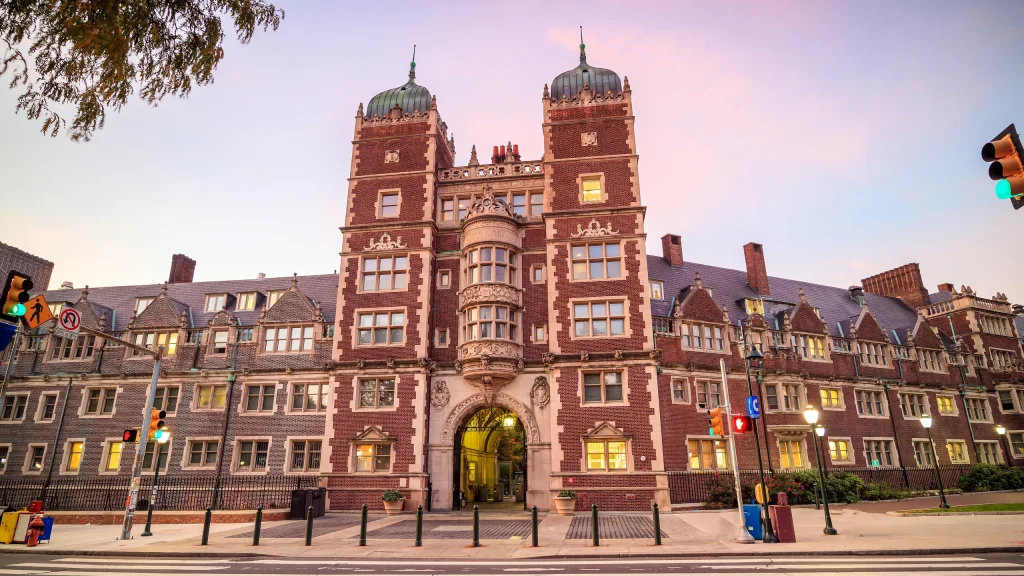
University of Pennsylvania: A Simple Guide for Students Thinking of Applying
University of Pennsylvania admissions attract applicants worldwide for one clear reason. Penn combines Ivy League prestige with a genuinely unique academic structure that lets students combine business, engineering, nursing, and the arts across four coordinated schools. This guide breaks down admissions, real costs, and student life for international students everywhere considering Pennsylvania.
What Is the University of Pennsylvania?
The University of Pennsylvania, widely known as Penn, is a private Ivy League research university founded in 1740 in Philadelphia. It currently ranks seventh among US national universities and twelfth globally according to the QS World University Rankings 2026.
Penn stands out within the Ivy League for one specific reason. It runs four coordinated undergraduate schools instead of one, which lets students pursue joint degrees that blend fields most universities keep separate. Its Wharton School holds the top spot globally for undergraduate business education.
University of Pennsylvania Tuition Fees and Costs
Many applicants specifically search for Penn tuition fees before applying. Annual tuition for the 2025-26 academic year runs at $65,670, and this figure applies equally to domestic and international students. Add living expenses of roughly $20,600 per year, and the total cost of attendance reaches close to $94,600.
These numbers look intimidating on paper, but Penn backs them with substantial need-based aid. Penn meets 100% of demonstrated financial need for admitted students who qualify, and roughly 46% of students receive aid, with average packages reaching around $48,000 per year.
One important detail sets Penn apart from a handful of peer Ivy League schools. Penn does not admit international undergraduates on a need-blind basis, which means financial aid applications can factor into admissions decisions for non-US applicants in a way they do not for domestic students.
University of Pennsylvania Scholarships for International Students
Penn awards financial aid almost entirely through need-based grants rather than loans, and it does not offer merit scholarships to undergraduates at all. Admitted international students with demonstrated need can receive a Penn Undergraduate Financial Aid Grant that covers a portion of costs based on their specific financial circumstances, up to the full cost of attendance in qualifying cases.
Penn also maintains a number of donor-funded, endowed scholarship funds earmarked specifically for international undergraduates. The financial aid office typically identifies eligible recipients automatically during the standard aid review process, so applicants generally do not need to apply separately for these named funds.
Because Penn is not need-blind for international applicants, students who genuinely need aid should still apply for it. Weigh your specific financial situation carefully, since going without aid can occasionally support a stronger admissions case, though Penn explicitly states it wants finances accessible for all qualified students.
How Does Admissions Work?
International undergraduate applicants apply through the Common Application, the same system many other US universities use, and Penn evaluates applications holistically rather than through rigid cutoffs. Students hoping to apply for financial aid also submit the CSS Profile, generally due by January 15 for Regular Decision.
A few things that help your Penn admissions application:
Penn accepts SAT and ACT scores but does not require them, so a genuinely strong academic record and rigorous course load still carry significant weight regardless of your testing choice. English proficiency tests like TOEFL, IELTS, or Duolingo matter for most non-native English speakers, so confirm your specific school’s requirement early. Penn’s acceptance rate sits below 5%, making it one of the most selective universities in the country, so genuinely distinctive essays and extracurricular depth matter as much as grades.
Confirm your exact deadline based on your chosen plan. Early Decision generally falls around November 1, and Regular Decision generally falls around January 5, though applicants should always verify current dates on Penn’s official admissions calendar.
What Will You Study?
Penn’s four undergraduate schools cover the College of Arts and Sciences, the School of Engineering and Applied Science, the School of Nursing, and the Wharton School of business. This structure lets students build joint degrees across fields that most universities keep in separate silos.
Wharton holds the top global ranking for undergraduate business education and the number two spot for its MBA program, giving Penn a genuinely rare concentration of business talent alongside its strong liberal arts and engineering programs.
Penn produces research output across an unusually wide range of fields, supported by real interdisciplinary collaboration between its schools, a structure that sets it apart from many peer Ivy League institutions.
What Is Campus Life Like?
Penn’s campus sits in Philadelphia, a major East Coast American city with deep historical roots and strong ties to finance, medicine, and law. Students get direct access to a large city while still enjoying a defined, walkable campus core.
Penn enrolls a large international student population across its undergraduate and graduate schools, supported by dedicated International Student and Scholar Services for visa, immigration, and cultural adjustment guidance. Most first year students live in university housing as part of a structured residential program.
Philadelphia experiences a genuine four-season year, including real winters with snow and cold temperatures. Students coming from consistently warm climates should prepare for a real seasonal adjustment.
What Happens After Graduation?
Penn graduates, particularly from Wharton, carry serious weight with major employers in finance, consulting, and business, given the school’s global reputation and deep industry connections. Graduates across Penn’s other schools also see strong outcomes in law, medicine, engineering, and technology.
International graduates generally need employer sponsorship for a US work visa to stay and work long term, and Penn’s career services offices run dedicated support to help international students navigate this process during their final year.
Advice for International Students
If you are applying to the University of Pennsylvania from anywhere in the world, keep these points in mind.
Understand that Penn is not need-blind for international applicants, unlike a small number of peer universities, so weigh your financial aid strategy carefully alongside your overall application.
Apply for the CSS Profile by its January 15 deadline if you plan to seek aid, since missing this window can limit your eligibility for the academic year.
Consider whether Penn’s joint-degree structure across its four undergraduate schools fits your specific academic interests, since this flexibility represents one of Penn’s most distinctive strengths.
Research Philadelphia’s climate and cost of living honestly, particularly if you come from a warm climate, since winters and total costs both run higher than many students expect.
Conclusion
University of Pennsylvania admissions offer a genuinely distinctive opportunity among Ivy League universities, a joint-degree academic structure, a world-leading business school in Wharton, and substantial need-based aid for admitted students who qualify. Its Philadelphia location, strong graduate outcomes, and interdisciplinary academic culture make it a compelling choice for ambitious students from any country. Research your specific school’s requirements and the CSS Profile deadline early, and weigh Penn’s international financial aid policy carefully as you plan your application.
Frequently Asked Questions
What is University of Pennsylvania tuition for international students? Annual tuition for the 2025-26 academic year runs at $65,670, the same rate charged to domestic students, with total cost of attendance including living expenses reaching close to $94,600.
Is Penn need-blind for international students? No. Penn evaluates international undergraduate applicants on a need-aware basis, though it meets 100% of demonstrated need for admitted students who qualify for aid.
Does Penn offer merit scholarships to international students? No. Penn does not award undergraduate merit scholarships. All undergraduate financial aid is need-based and delivered mainly as grants rather than loans.
Is Penn only good for business through Wharton? No. While Wharton ranks first globally for undergraduate business education, Penn also runs strong programs in engineering, nursing, and the arts and sciences through its other three undergraduate schools.
Check or Visit the school official website: University of Pennsylvania Admissions
Want to compare University of Pennsylvania with other top universities for scholarships? Browse our other Universities guides, or check Scholarships for more funding options.
Leave a Reply