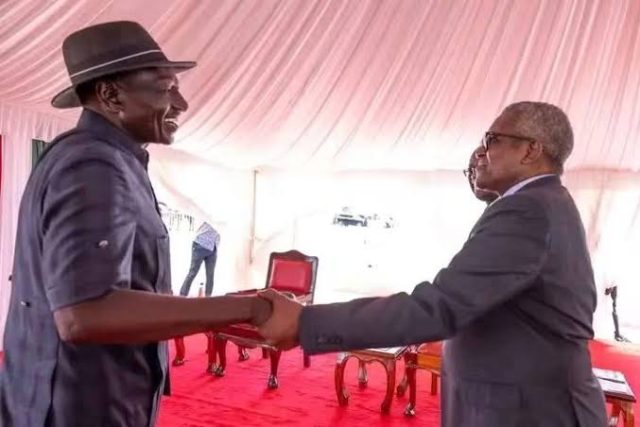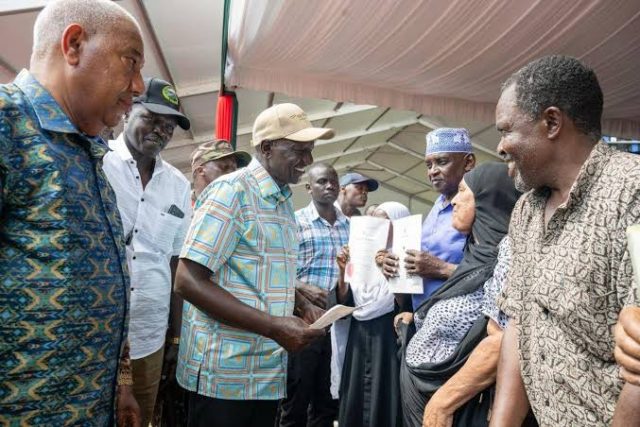


A mausoleum built in honour of the late former Prime Minister Raila Odinga has been formally handed over at Kang’o Ka Jaramogi in Bondo during a ceremony that brought together family members, political leaders and supporters.
The dedication ceremony took place on Wednesday, October 7, with President William Ruto among the senior leaders in attendance.
ODM leader Oburu Oginga was unable to attend the event in person because he remains hospitalised in Nairobi.
His son, Jaoko Oburu, represented him at the ceremony and delivered a prepared tribute on his behalf.
Jaoko told those gathered that his father was recovering and had expressed gratitude for the prayers and support he had received.
Oburu Describes Mausoleum as More Than a Resting Place
In the message read to the congregation, Oburu described the mausoleum as a lasting symbol of the political struggle that shaped Kenya’s democratic journey.
He said the monument should not be viewed simply as a burial site but as a place representing freedom, constitutionalism and the pursuit of justice.
The tribute reflected on the role played by different generations of the Odinga family in Kenya’s political history.
It traced that journey from Jaramogi Oginga Odinga, who played a prominent role in the country’s early independence politics and the campaign for political pluralism, to Raila Odinga’s long involvement in democratic reforms.
The family tribute also linked Raila’s political journey to the reform movement that eventually led to the adoption of Kenya’s 2010 Constitution.
Raila and Jaramogi Remembered Together
The mausoleum was completed within about three months and now serves as the final resting place of both Raila Odinga and his father, Jaramogi Oginga Odinga.
Raila died on October 15, 2025, making the ceremony particularly significant as the country approaches the first anniversary of his death.
The monument is expected to serve as both a memorial and a historical site dedicated to the political legacy associated with the Odinga family.
For supporters attending the ceremony, the dedication provided another opportunity to reflect on Raila’s decades-long involvement in Kenya’s political and democratic movements.
Oburu Addresses His Health From Hospital
Oburu also used the tribute to briefly address his health and explain why he could not attend the ceremony.
He said he was following instructions from his doctors to rest and reduce physical activity.
Despite his absence, he said his thoughts remained with the family, leaders and supporters gathered in Bondo.
His message sought to reassure supporters that he remained engaged with the political cause and the legacy being celebrated during the ceremony.
Broad-Based Government Praised in Tribute
The tribute also touched on ODM’s participation in the broad-based government.
Oburu pointed to several government programmes as examples of what he said political cooperation could achieve.
Among the initiatives mentioned were the National Infrastructure Fund, universal healthcare under the Social Health Authority framework, fertiliser subsidies and reforms in the education sector.
The remarks presented political unity as a possible route toward addressing some of the country’s economic and social challenges.
Tribute Ends With Call to Preserve Raila’s Legacy
Oburu’s message concluded by urging supporters to continue preserving Raila’s political legacy and the ideals associated with his public life.
The tribute repeatedly referred to Raila by his popular political name, “Baba,” and called on supporters to keep his memory alive.
The mausoleum ceremony therefore served not only as a formal handover of the structure but also as a wider reflection on Raila’s political influence and his place in Kenya’s recent history.
Oburu’s Office Rejects Online Death Claims
Away from the ceremony, Oburu’s secretariat also responded to social media reports falsely claiming that the ODM leader had died.
His office rejected the claims and criticised those responsible for spreading the information online.
The secretariat specifically accused blogger Maverick Aoko of contributing to the circulation of the reports and called for greater responsibility when sharing information on social media.
It also indicated that the matter could be pursued through legal channels in consultation with ODM leadership.
The statement came as Oburu continued receiving treatment in Nairobi, with his family maintaining that he was recovering.
Conclusion
The formal handover of Raila Odinga’s mausoleum at Kang’o Ka Jaramogi marked another important moment in efforts to preserve the former prime minister’s political legacy.
Although Oburu Oginga could not attend because of his health, his tribute placed the ceremony within the wider history of Kenya’s democratic struggles and the political role played by the Odinga family.
As Kenya approaches the first anniversary of Raila’s death, the Bondo mausoleum is likely to remain a significant memorial site for supporters, political leaders and visitors seeking to reflect on his contribution to the country’s political history.