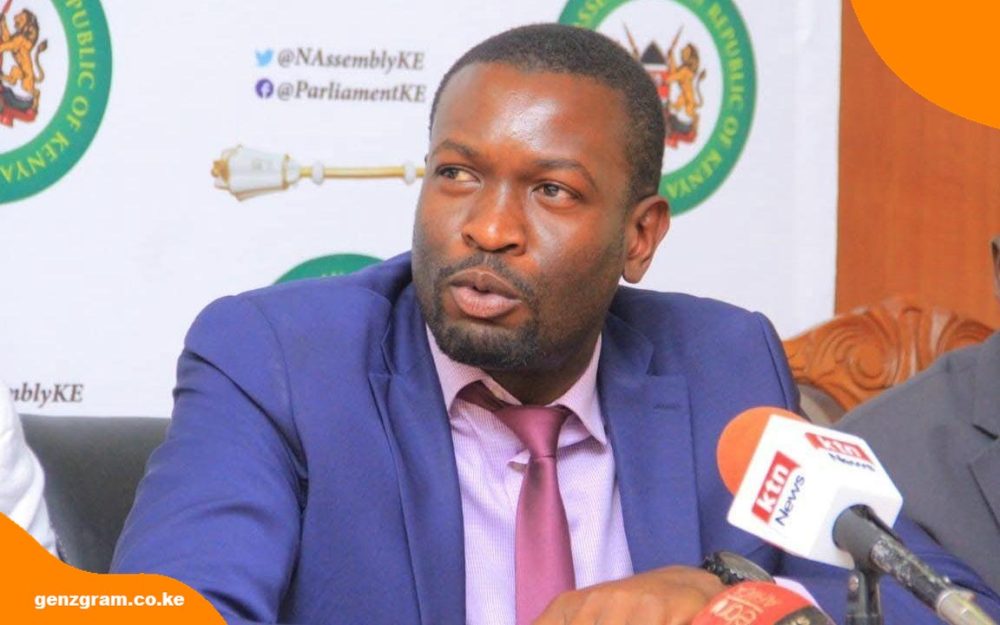
Edwin Watenya Sifuna is one of the most prominent Kenyan opposition politicians, the vocal Secretary-General of the Orange Democratic Movement (ODM), and the Nairobi Senator vying for his political slot and promoting his own brand of politics. Career politician, Sifuna has traversed the hierarchies of the legal system, the ODM party apparatus, and the Kenyan parliament. The career path is entwined with both the late Raila Odinga, whom he worked close with, and bitter succession wrangles from within the ODM ranks. With Kenya teetering on the brink of the 2027 General Election, Sifuna has decided to carve a niche for himself as a presidential candidate.
But who is Edwin Sifuna? Read on to find out more.
Early Life and Education
Edwin Watenya Sifuna was born on May 22, 1982. He attended Kakamega Township Primary School, followed by Musingu High School.
Afterwards, Sifuna joined the University of Nairobi, where he studied law and obtained a postgraduate diploma from the Kenya School of Law in 2007. It is his legal training that provided the foundation for a career that took him into party politics and into the Parliament.
According to his parliamentary profile, Sifuna’s professional background is in law, and his political career progressed via his associations with ODM.
From the Legal Profession to Politics
Prior to becoming a household name in the Kenyan political firmament, Sifuna was a lawyer. His work and commitment in the fields of law and public affairs, however, provided the right platform for his political career.
Quickly became a prominent figure in the politics of Kenya, as he was one of the few people who could present the views of the ODM to the public with so much vigor.
Sifuna was able to gain a lot of prominence in the political arena by voicing the party line to the media with so much conviction.
It is also in this field that he earned recognition as a man of his word for being able to present the party’s position on various issues and stand by it. The position he held in the party as the Secretary-General meant he had to deal with the other media personalities directly.
It is through these actions that Sifuna becomes one of the most recognized and respected politicians in Kenya. In addition to being the Secretary-General of the ODM, a post that he held until 2018, he was the main man who delivered the party’s message to the Kenyan people.
How Raila Odinga Shaped His Political Journey
The rise of Sifuna is impossible to discuss without mentioning his political relations with Raila Odinga.
Raila was one of Kenya’s most popular opposition figures and de facto leader of ODM for many years. Being the secretary-general of a party that put its candidates in the presidential race and engaged in nationwide political negotiations gave Sifuna both credibility and exposure.
Sifuna has repeatedly denied reports that he and Raila had fallen out before the latter’s death, telling The Star in October 2026 that the latter had insisted on his remaining as secretary-general when he vacated the post in favor of another person.
Raila’s passing presented ODM with the need to reorient itself, redefining its role in the national political system, its approach to the government, and its internal leadership. At the same time, it placed many of its former allies in an unprecedented position where they were obliged to formulate their own views on politics.
For Sifuna, it meant overcoming the status of an aide to a popular politician and engaging in the development of his own political course that would withstand the competition from within his party.
Winning the Nairobi Senate Seat
In the 2022 General Election, Sifuna was elected Nairobi Senator on an ODM ticket.
This saw him rise from party administrator to electoral office as he was mandated to represent the capital in the Senate.
The Senate provides a forum for representing the county, debating matters of public interest, and exercising checks and balances on matters affecting the counties.
The position also gave him a platform to play a leading role in the national debate on matters including public spending, leadership and governance, and revenue and taxation.
His slot in the Parliament further enhanced his profile as he continued to serve as ODM Secretary-General.
At the same time, the two jobs meant that he was at the crossroads of the more intricate political challenges facing his party.
The ODM Fallout That Changed His Political Direction
One of the most crucial political moments of Sifuna’s career took place when he opposed the ODM leadership on issues concerning party politics and its stance towards the president of the Republic of Kenya, William Ruto.
Sifuna positioned himself in the company of those who believed that ODM should retain its identity as a party of the alternative and not adopt a more broad-based approach characteristic of the government in which he had to function with a certain degree of autonomy.
The conflict erupted with his removal as the Secretary General of the party, which he contested in the internal ODM dispute-resolution mechanisms.
In his interview with The Star on October 10, 2026, Sifuna claimed that Ruto influenced the decision to remove him even though he pardoned the ODM officials involved in the conflict.
This is what Sifuna wanted the public to know about the troubles within the ODM party, and the fallout was significant for his subsequent political course.
While he lost the internal party elections, he did not turn to full-scale opposition to Ruto on the national stage but instead focused on building his political brand as an alternative to the sitting president.
However, instead of staying in the shadows and supporting his presidential candidates in the local elections, Sifuna started to build his political movement.
The Linda Mwananchi Movement and His Presidential Ambitions
Sifuna’s presidential ambitions became public in 2026 as he started attending rallies and looking for a new vehicle for his campaign.
On October 4, 2026, he officially launched the Equitable Party (TEP) as his party for the 2027 general election. The party representatives unmasked him as their presidential candidate.
His new political vehicle has been associated with the Linda Mwananchi movement, which is a conglomeration of politicians who are dissatisfied with the government’s performance and whose supporters are longing for a change.
According to The Standard, the new outfit has a reform program that targets corruption, tribalism, and inequality and calls for more responsive government.
On October 10, Sifuna stated that his short-term plan was to lay foundations and finalize preparations for the formation of the party machinery before negotiating alliances. In addition, the president-designate revealed that the request to change the name of the party to the Linda Mwananchi Movement was pending at the Office of the Registrar of Political Parties.
Indeed, his ambitions have crossed the line as he is now looking to construct a structure through which he can vie for the presidency.
However, the statement of presidential intentions is just one step in the road. There is still a lot more to do in order to create a working party, build a statewide organization, and fulfill legal requirements for the election.
What Does Sifuna Want to Change?
Sifuna focuses on public spending and taxes as matters of his utmost importance.
In his interview in the media in October 2026, he claimed that there would be money to reduce public spending by over KSh 500 billion by cutting down on “wasteful” government spending. He says that the amount could be achieved by saving.
The amount is his personal estimate, and it is not necessarily the amount that any future administration would unquestionably save.
His rhetoric focuses on corruption, inequality, tribalism, and governance.
The crucial point is the articulation of priorities because what the politicians are proposing will most likely come down to specific policies. Some of the issues he brings up, such as waste, will require a strategy that will see the government cutting expenditures while still providing adequate services and managing the debt. The policies may also entail setting standards for measuring progress in terms of ordinary citizens’ lives.
To evaluate his proposals for the presidency, these ideas must be considered in the context of his parliamentary performances, as well as the concrete plans that his party’s leadership will unveil.
The Challenges Ahead
Sifuna’s presidential project has several challenges ahead of him.
Firstly, a presidential campaign needs a national political organization. His visibility in Nairobi and his party’s ranks is not enough; he will need to build a presidential campaign and create positions at all levels.
Second, Kenyan elections are characterized by coalitions, regionalism, party nominations, and the ability to deliver in various communities. His new movement needs to decide what its political course and strategy in coalition politics will be.
Third, he needs to develop his independent political identity, separate from Raila Odinga and the ODM. His previous party affiliation and associated parliamentary seat gave him visibility and a platform; his new political course needs to define itself and its alternatives.
Fourth, he needs to develop a program that will resonate with voters and answer the economic policy questions that the country is being asked.
These are the kinds of challenges that any president-elect will have to face, and it remains to be seen what choices he will make in the areas of political organization, program, and election campaign.
Is Edwin Sifuna Preparing for a New Political Era?
Sifuna’s political career has transitioned from his profession as a lawyer to leading the party, being elected into the post of the senator, and now being a presidential candidate.
Raila Odinga’s mentorship gave him a platform to engage in national politics. The election into the Nairobi Senate provided him with more public following, whereas the intra-party disagreement opened up new ideas for him.
The creation of The Equitable Party as his new political movement in October 2026 demonstrates that he is pursuing a fresh approach to Kenyan politics. The rebranding of the brand associated with Linda Mwananchi suggests that he tries to build his own unique identity.
Whether his new project will turn into a successful national opposition depends on his team, policies, negotiation skills, and public support. For now, Edwin Sifuna’s political biography remains a path from the influential lawyer to the president’s post.
Follow Our WhatsApp Channel For Daily Realtime News Updates