
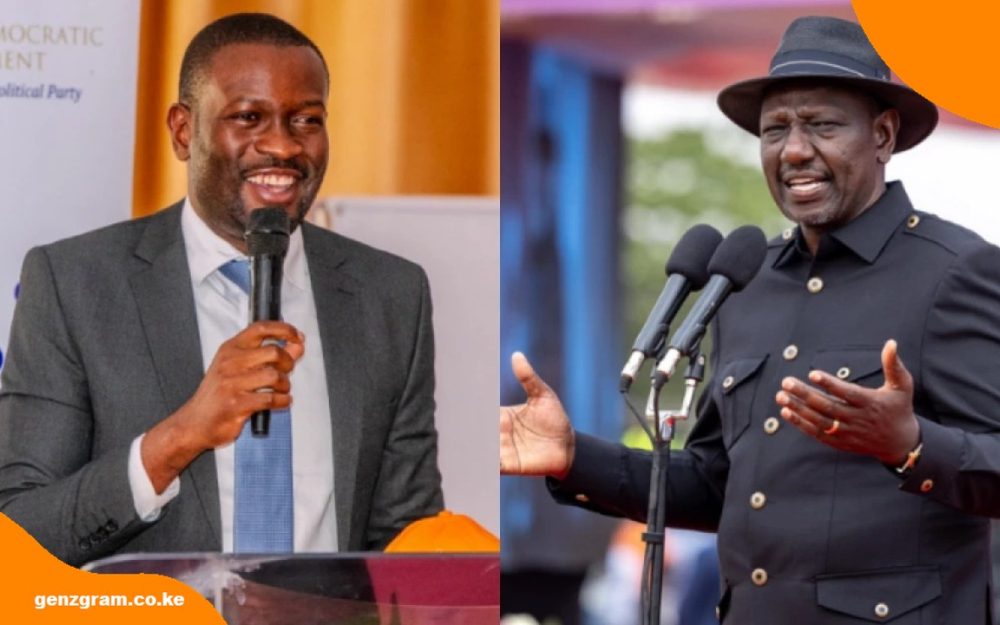
Kenya’s 2027 presidential race is beginning to take shape, and one of the most closely watched political questions is whether Nairobi Senator Edwin Sifuna can mount a serious challenge to President William Ruto.
Sifuna, once widely recognised for his role in the Orange Democratic Movement (ODM), has increasingly positioned himself as a leading voice of opposition to the current administration. His growing political profile, public rallies and push for a new political vehicle have placed him in a national conversation that extends beyond his Nairobi Senate seat.
Ruto, meanwhile, enters the contest as the incumbent president, with the advantages of national visibility, an established political network and the machinery of government. However, his re-election campaign will also face scrutiny over the economy, the cost of living, employment, taxation and public services.
With Kenyans expected to vote in August 2027, the question is no longer simply whether Sifuna can attract attention. It is whether he can convert that attention into a nationwide electoral coalition capable of challenging an incumbent president.
Sifuna’s growing presidential ambitions
Sifuna’s political journey towards the 2027 race has gathered momentum in recent months. The Nairobi senator has become one of the administration’s most outspoken critics, using public meetings and media appearances to question government policies and demand accountability.
His political direction became clearer after his fallout with ODM, where he had served as secretary-general. The dispute and his removal from key party positions created uncertainty about his future within the party but also opened the way for him to pursue a different political path.
In July 2026, Sifuna publicly left open the possibility of running for president, saying the decision would depend on consultations and the wishes of supporters.
By October, his presidential ambitions had become more concrete. The Linda Mwananchi Movement endorsed him as its preferred candidate, while The Equitable Party emerged as the political vehicle associated with his campaign. On October 18, Sifuna said the movement believed it could defeat Ruto and urged opposition leaders to unite around a common political agenda.
His appeal appears to rest partly on his reputation as a vocal critic of the government and his ability to communicate political arguments in a direct, accessible manner.
However, a presidential campaign requires more than public visibility. Sifuna must build structures across all 47 counties, recruit credible candidates, raise campaign funds, mobilise voters and establish a convincing policy agenda.
He must also persuade voters outside his strongest support networks that his leadership programme addresses their concerns.
Ruto’s advantage as the incumbent
President William Ruto remains a major force in the 2027 race. As the sitting president, he has national recognition, an established political party and a network of allies and elected leaders capable of mobilising support.
His administration can point to its policy programmes and development priorities as part of its case for another term. The president’s campaign is also likely to emphasise continuity, economic management and the implementation of government projects.
Yet incumbency does not guarantee re-election.
The cost of living, taxes, access to healthcare, unemployment and the financial pressures facing households are likely to feature prominently in voters’ assessments of the administration.
Ruto will need to convince Kenyans that his government’s policies are producing tangible improvements in their daily lives. His opponents, in turn, will attempt to persuade voters that the country needs a different approach.
The president’s ability to retain support across regions that backed him in 2022 could therefore be an important factor in determining his political prospects.
What do the latest opinion polls say?
A Politrack Africa survey published by Daily Nation on October 4 placed Ruto at 45.1% in presidential preference, while Sifuna received 19.6%.
The figures put Ruto ahead in that particular survey, with Sifuna emerging as the leading individual opposition contender. However, the results also suggest that the opposition’s broader political picture remains unsettled.
Ruto’s reported 45.1% was below the more than 50% of votes required to win the presidency in the first round, alongside the constitutional requirement to obtain at least 25% of votes cast in more than half of Kenya’s counties.
The poll should not be interpreted as a prediction of the final result. It measures preferences at a particular point in time, and voter attitudes may change as campaigns develop, candidates are formally selected and coalitions take shape.
The figures also do not mean that every voter currently supporting another opposition candidate would automatically transfer their support to Sifuna in a joint contest.
For Sifuna, the poll offers evidence of national visibility but also highlights the distance between being a prominent challenger and assembling a winning electoral coalition.
For Ruto, the lead represents a position to defend rather than a guaranteed path to another term.
The opposition unity question
One of the most important uncertainties ahead of 2027 is whether opposition leaders can agree on a common presidential candidate.
Several political figures are positioning themselves for the contest, while discussions continue about possible alliances and a shared opposition strategy.
If Sifuna seeks to become the joint opposition candidate, he will need to negotiate with other leaders who have their own political ambitions, established support bases and regional constituencies.
A united opposition could potentially pool campaign resources, coordinate voter mobilisation and avoid splitting votes among competing candidates. But unity would require compromises over the presidential ticket, running mate, policy priorities and the distribution of political responsibilities.
Sifuna’s growing prominence does not automatically make him the opposition’s final choice. That outcome will depend on negotiations, political agreements and the willingness of rival aspirants to support a common candidate.
The ability to build bridges beyond his immediate political base may prove just as important as his performance at rallies.
What could determine the 2027 winner?
Several factors are likely to shape the contest.
The economy: Voters will assess the cost of living, taxation, employment opportunities and the performance of the economy. Both candidates will need to explain how their policies would affect ordinary households.
Regional support: Neither candidate can rely solely on enthusiasm in a limited number of counties. A credible presidential campaign must establish broad support and satisfy the constitutional requirements for election.
Campaign organisation: Party structures, fundraising, polling agents, local mobilisation and effective communication will influence each campaign’s ability to turn support into votes.
Coalition building: Alliances with influential leaders and political parties could reshape the contest. The final configuration of the opposition may be particularly consequential.
Public trust and accountability: Voters may also consider each candidate’s record, credibility, policy proposals and ability to respond to public concerns.
These factors will interact in ways that cannot be reliably determined from a single opinion poll.
So, who will take the seat?
At this stage, Ruto has the stronger position in the cited presidential preference survey, while Sifuna has emerged as a significant opposition contender whose political fortunes have attracted growing attention.
The two face different challenges. Ruto must defend his administration’s record and maintain a broad electoral coalition. Sifuna must transform his growing profile into a well-organized national campaign and navigate the complicated process of opposition coalition building.
The coming months will reveal whether Sifuna can expand his support beyond his existing base and whether the opposition can agree on a common candidate. They will also show whether Ruto can maintain his polling lead as campaign issues become more defined.
Ultimately, the presidency will not be decided by social media arguments, rally attendance, or early polling figures alone. It will be decided by voters in the 2027 General Election under Kenya’s constitutional electoral framework.
For now, the most accurate conclusion is that Ruto leads in the cited poll, Sifuna is positioning himself as a serious challenger, and the final outcome remains uncertain.
The big question for Kenyans is whether the emerging opposition movement can turn its growing political energy into a coordinated national alternative before election day.
Follow Our WhatsApp Channel for Daily Real-Time News Updates