

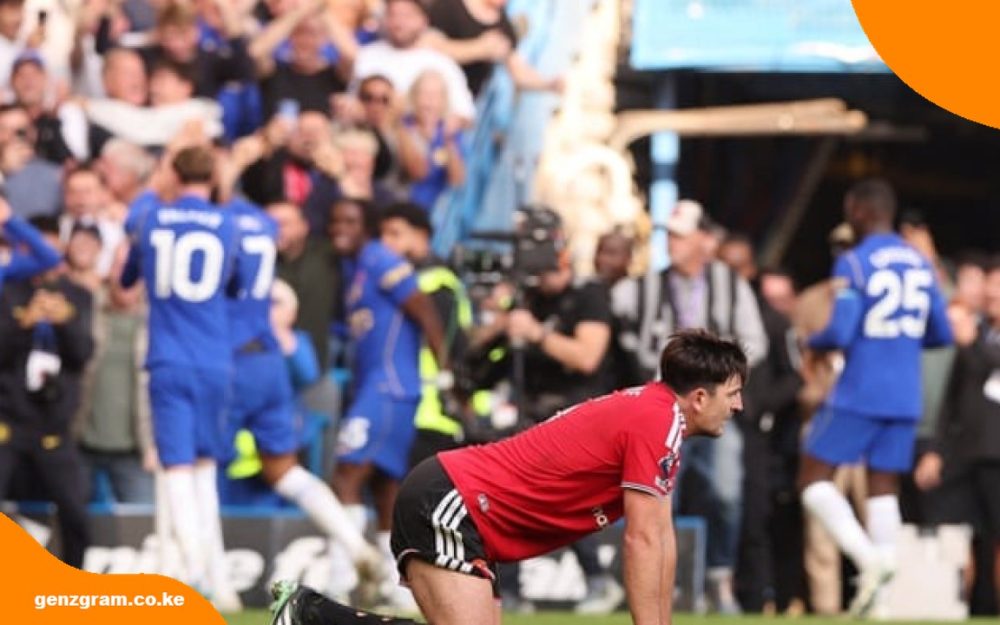
Manchester United supporters have endured another frustrating afternoon after their team fell 2–0 to Chelsea in the Premier League on Saturday, October 31, 2026.
The defeat was damaging not only because of the result but also because of the manner in which United lost control of the contest. A promising first-half performance was followed by defensive mistakes, missed opportunities and a second-half collapse that left head coach Michael Carrick facing renewed questions about his future.
Morgan Rogers opened the scoring for Chelsea shortly after the interval before Cole Palmer converted a penalty following Lisandro Martínez’s dismissal. The Argentine defender received a second yellow card after a VAR review of his challenge on Wesley Fofana, leaving United with ten players and an even more difficult task.
For Carrick, the result represents another setback in a season that is increasingly becoming difficult to explain to an increasingly impatient fanbase.
According to match reports, United’s winless run in all competitions has now reached nine games, their longest such sequence since 1988. The club was also left dangerously close to the Premier League relegation zone, with its position depending on other results during the weekend.
The pressure is therefore no longer limited to criticism of individual performances. Questions are increasingly being directed at the man responsible for organising the team and finding a way out of the crisis.
A promising first half that produced no reward
There was a period during the first half when United looked capable of leaving Stamford Bridge with a positive result.
Carrick restored Bruno Fernandes to the starting line-up after the captain had been left out against Bournemouth. His return appeared to improve United’s attacking movement, while Matheus Cunha, Amad Diallo and Bryan Mbeumo offered moments of danger.
United created opportunities but struggled to convert them.
Fernandes missed a particularly important chance, firing over after receiving a pass from Mbeumo during a promising attacking move. Diallo also had opportunities, while Cunha saw an effort ruled out for offside following a VAR review.
Chelsea, meanwhile, had their own moments but did not look particularly comfortable during the opening period.
The problem for United was familiar: creating opportunities without demonstrating the composure and quality required to turn them into goals.
Against a team of Chelsea’s quality, failing to take advantage of a promising first half can be costly. United discovered that the hard way after the break.
Morgan Rogers exposes United’s defensive problems
Chelsea needed only a few minutes after the restart to take the lead.
Morgan Rogers drove forward through the middle of the pitch, finding far too much space as United’s defensive structure failed to stop his advance. He entered the penalty area before lifting a composed finish over goalkeeper Senne Lammens.
It was a moment of individual quality from Rogers, but it also exposed a worrying lack of defensive organisation from the visitors.
United’s defenders appeared unable to close down the midfielder or prevent him from progressing towards goal. The ease with which Chelsea moved into a dangerous position raised further questions about the team’s ability to defend as a collective unit.
The goal changed the mood of the match. United were now chasing an equaliser, while Chelsea had the confidence to exploit the spaces opening up.
The situation became considerably worse when Martínez was dismissed.
Martínez’s red card makes matters worse
Martínez’s sending-off proved to be a decisive moment in the contest.
The defender had already received a yellow card for a foul on Rogers. He was then involved in another incident during a Chelsea corner, raising his arm towards Fofana.
Following a VAR review, referee Peter Bankes awarded Chelsea a penalty and showed Martínez a second yellow card.
Palmer stepped forward and converted from the spot, putting Chelsea 2–0 ahead in the 64th minute.
United were now facing two problems: a two-goal deficit and the challenge of completing the match with ten players.
Although Bryan Mbeumo later struck the crossbar, United could not produce the comeback required to change the outcome.
For Carrick, the red card was another example of how quickly the match had slipped away from his side. However, Martínez’s dismissal cannot explain the missed opportunities in the first half or the defensive vulnerability that allowed Rogers to score.
Those are problems that require attention beyond one controversial or costly moment.
Is Michael Carrick the right man to rescue Manchester United?
This is now the question dominating conversations among United supporters.
Carrick understands the club from the inside. He played for Manchester United during a successful period in its history, winning major trophies and working under one of football’s most respected managers, Sir Alex Ferguson.
His familiarity with the club’s culture and expectations could be an advantage during a difficult period. He also has experience of the pressures that come with representing Manchester United, both as a player and as a coach.
But understanding the club’s history is not the same as successfully managing its present-day problems.
A manager at a club of United’s size must demonstrate tactical clarity, consistency, strong dressing-room management and the ability to get results under pressure.
At the moment, the results are not providing Carrick with much protection.
The nine-game winless run is a major concern, particularly when considered alongside the recent defeats to Como and Bournemouth. United have also struggled to turn promising attacking periods into victories.
The question is whether Carrick has identified the reasons behind the decline and whether he can implement changes quickly enough to reverse it.
There is a reasonable argument for giving a manager time to build a team, especially when the club is experiencing instability. However, patience becomes harder to justify when poor results continue and the team appears to repeat the same mistakes.
Is the problem bigger than the manager?
While Carrick is the most visible figure in the current crisis, focusing entirely on the head coach may overlook other issues affecting Manchester United.
The club has experienced repeated changes in management, recruitment strategies and football leadership since Ferguson’s departure. Different managers have arrived with different philosophies, but the club has struggled to establish sustained success.
That history raises a difficult question: can another managerial change solve problems that may extend beyond the person in the dugout?
Players must also accept responsibility.
United missed chances that could have changed the match against Chelsea. Defensive players failed to stop Rogers, while Martínez’s dismissal left the team in an even more difficult position.
A manager can prepare a team, select a formation and communicate instructions, but players must execute those plans on the pitch.
The relationship between the manager and the squad is equally important. Recent reports have highlighted tensions involving Fernandes and Carrick’s tactical decisions, while Martínez has also attracted attention after criticising the club’s hierarchy.
Such developments make it important for United’s leadership to understand whether the current problems are primarily tactical, disciplinary, structural or a combination of several factors.
Replacing Carrick without addressing those issues could simply create another short-lived change.
What must Carrick do to change the conversation?
The immediate priority is to stop the losing and winless sequence.
United need to rediscover defensive organisation, improve their finishing and demonstrate greater control during difficult moments. The team cannot continue creating chances without taking them, nor can it afford to concede goals through avoidable defensive errors.
Carrick must also find a way to restore confidence among his players.
A team that has gone several matches without winning can begin to approach every game with anxiety. Players may become hesitant, make unnecessary mistakes or lose belief after conceding the first goal.
The manager’s responsibility is to rebuild that confidence while maintaining accountability.
United’s next assignment is a Champions League home match against Roma on Tuesday, November 3. It presents Carrick with an immediate opportunity to respond, although the pressure surrounding his position is unlikely to disappear without a significant improvement.
A defining period for Manchester United
Manchester United remain one of the most recognisable clubs in world football, but reputation and history cannot compensate for poor performances.
The defeat at Chelsea has exposed several areas requiring urgent attention: defensive discipline, clinical finishing, tactical organisation and the team’s ability to respond when circumstances become difficult.
Carrick now faces a defining period in his spell as head coach. His supporters can point to the promising first-half display and argue that the team showed enough quality to compete. His critics, however, can point to the nine-match winless run and the repeated failures that have left United in a precarious position.
Both sides of the argument raise important questions.
Perhaps the bigger issue is not simply whether Carrick deserves more time. It is whether Manchester United’s leadership has a clear plan for rebuilding the team and whether the current manager is the person capable of delivering it.
For a club that has spent years searching for stability, another managerial change would be a significant decision. Keeping Carrick would also require evidence that the current direction can produce better results.
So, Manchester United fans, is Michael Carrick the right man to rescue the Red Devils, or has the time come for the club to consider another change in the dugout?


Comments
Please keep it respectful. Links, phone numbers and adverts are not allowed and will not be posted.