
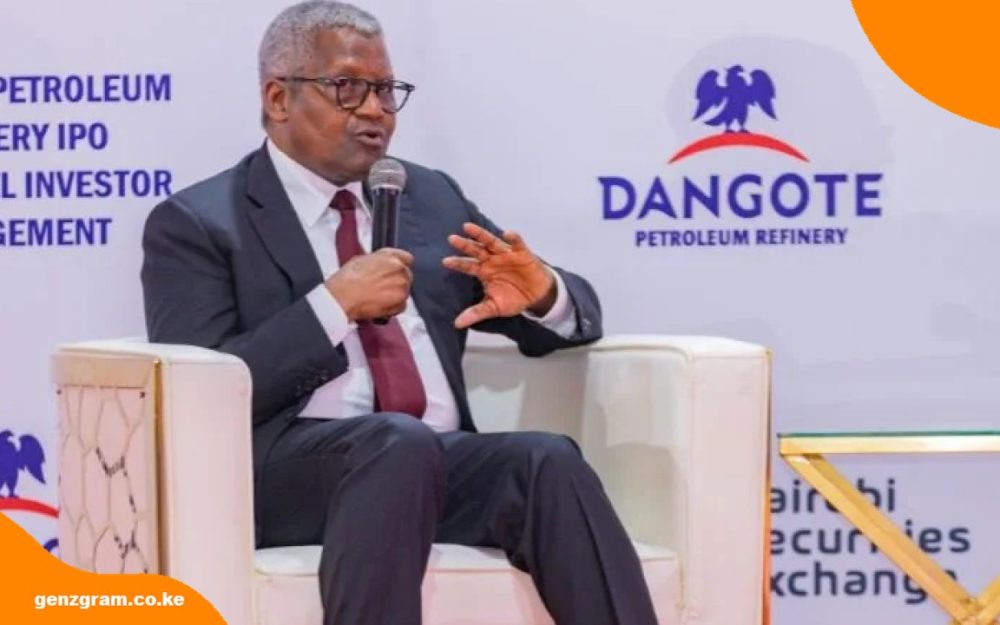
Nigerian billionaire Aliko Dangote has confirmed acquiring a 24.76 per cent stake in Kenya Pipeline Company (KPC) in a transaction valued at approximately KSh42.5 billion, marking a major development in Kenya’s petroleum industry.
The acquisition makes Dangote one of the largest shareholders in the company responsible for transporting petroleum products from the Port of Mombasa to inland markets and neighbouring countries.
Dangote disclosed the investment on Wednesday, October 21, 2026, during the Financial Times Africa Summit in London. His announcement identified him as the investor behind a significant block of KPC shares that had recently changed hands on the Nairobi Securities Exchange (NSE).
The transaction comes as the industrialist advances plans to establish a major oil refinery in Lamu County, raising the possibility of closer links between petroleum refining, storage and distribution across East Africa.
How Dangote acquired the KSh42.5 billion stake
The transaction involved approximately 4.5 billion shares, representing 24.76 per cent of KPC’s issued shares.
Reports indicate that the shares were sold by public-sector institutions that had acquired holdings during the company’s initial public offering earlier in 2026. The block trade was recorded on the Nairobi Securities Exchange on October 19, with the shares changing hands at prices ranging from approximately KSh9.02 to KSh9.36.
Dangote subsequently confirmed that his business interests had acquired the stake, although he did not publicly identify the specific company within his wider business group that completed the purchase.
The transaction followed KPC’s listing on the Nairobi Securities Exchange in March 2026, after the government offered a substantial portion of the previously state-owned company to investors.
The government’s decision to sell shares was part of a wider effort to attract private investment and mobilise funds through the capital markets.
However, the sale of a large stake to a prominent private investor has also renewed questions about transparency, the identities of the selling institutions and the long-term implications of transferring ownership in strategic infrastructure.
Who owns Kenya Pipeline Company now?
Dangote’s investment gives him a substantial position in a company considered important to Kenya’s energy security.
Following the acquisition, reports indicate that the Kenyan government retains approximately 35 per cent of KPC, while Uganda National Oil Company holds about 20.15 per cent.
Dangote’s reported 24.76 per cent holding makes him the company’s second-largest shareholder, based on the reported ownership figures.
Shareholder Reported stake
Government of Kenya 35%
Aliko Dangote-linked investment 24.76%
Uganda National Oil Company 20.15%
Other shareholders combined Appr.09%
These figures are based on published reports and may require updating as formal disclosures clarify the final ownership structure.
Although Dangote’s stake could give him significant influence over shareholder decisions, it does not automatically establish that he controls KPC. Board representation and the ability to influence major corporate decisions depend on the company’s governance arrangements and applicable regulations.
The acquisition is nevertheless significant because it gives a major regional energy investor a substantial financial interest in the infrastructure used to transport petroleum products across Kenya.
Why Dangote is interested in Kenya’s pipeline network
The acquisition is closely linked to Dangote’s wider ambitions in the African petroleum market.
His business group already operates a major refinery in Nigeria and has been expanding its interests in fuel production and distribution. In Kenya, attention is also focused on the proposed refinery in Lamu County, a project announced with a planned processing capacity of 700,000 barrels of crude oil per day.
The Lamu project is intended to serve Kenya and potentially other markets in East and Central Africa. Its success would depend on several factors, including financing, construction, access to crude oil, market demand and the development of supporting infrastructure.
A stake in KPC could provide Dangote with a direct financial interest in an established petroleum transportation network that may complement the proposed refinery’s distribution needs.
Kenya Pipeline’s infrastructure transports fuel from Mombasa to inland depots and supports distribution to neighbouring markets. A more integrated arrangement between refining, storage and transportation could create commercial opportunities if the relevant projects proceed and agreements are reached.
However, the share acquisition does not automatically give Dangote exclusive access to KPC’s infrastructure. The company operates within an established regulatory and commercial framework, and any future arrangements would depend on applicable rules and agreements.
Dangote plans a further KSh194 billion investment
Beyond the share purchase, reports indicate that Dangote intends to invest approximately US$1.5 billion, equivalent to about KSh194 billion, in expanding KPC’s pipeline network.
The proposed investment could support additional transportation capacity and related infrastructure as demand for petroleum products grows across the region.
For Kenya, such an expansion could potentially strengthen fuel distribution and support the movement of petroleum products to inland markets. It could also provide additional capacity for regional trade if neighbouring countries increase their use of the network.
Nevertheless, the proposed investment should be distinguished from the completed share purchase. The KSh42.5 billion transaction concerns ownership of existing shares, while the additional KSh194 billion represents a reported investment plan.
The timing, financing structure, approvals and precise scope of the expansion will be important in determining how much of the proposal ultimately becomes a reality.
What could the deal mean for Kenyan consumers?
One of the biggest questions is whether the investment could eventually help reduce fuel costs.
An expanded pipeline network could improve transportation efficiency, support larger volumes and reduce some logistical constraints. Better integration between refining, storage and distribution could also improve the movement of fuel across the region.
However, consumers should not expect an immediate reduction in petrol or diesel prices simply because Dangote has acquired shares in KPC.
Pump prices are influenced by several factors, including international crude oil and refined petroleum prices, exchange rates, taxes, levies, shipping expenses, distribution costs and regulatory decisions.
Any savings from infrastructure improvements would depend on how the projects are implemented and whether the benefits are passed through the supply chain to consumers.
The acquisition could also raise questions about competition and access to essential infrastructure. Regulators will need to ensure that ownership changes do not undermine fair access or disadvantage other market participants.
Questions over public assets and transparency
The sale has also attracted attention because some of the shares were reportedly held by state-linked institutions and pension funds.
That raises important questions about how the transaction was structured, which institutions sold their holdings and whether the sale represented appropriate value for the assets.
Kenya’s government has defended the wider effort to attract private capital into strategic infrastructure, presenting such transactions as a way of encouraging investment and supporting economic development.
At the same time, public scrutiny is important when assets linked to public institutions change hands. Investors, pension contributors and taxpayers have an interest in understanding the terms of major transactions and their potential long-term consequences.
The Capital Markets Authority and other relevant institutions will also have a role in ensuring compliance with disclosure and takeover requirements that may apply to a transaction of this size.
A major development in East Africa’s energy sector
Dangote’s KSh42.5 billion investment places him among the most influential private investors in Kenya’s petroleum transportation industry.
Combined with his proposed refinery in Lamu and the reported plan to expand the pipeline network, the acquisition points to a broader strategy involving petroleum production, transportation and distribution.
Whether the investment eventually improves fuel availability, strengthens regional trade or reduces costs will depend on implementation, regulation and commercial arrangements.
For Kenya, the immediate task is to ensure that the investment delivers measurable economic benefits while protecting competition, transparency and the country’s long-term energy interests.
The share purchase is confirmed by Dangote’s public announcement, but the proposed expansion remains a separate plan whose final details and implementation will need to be followed closely.