

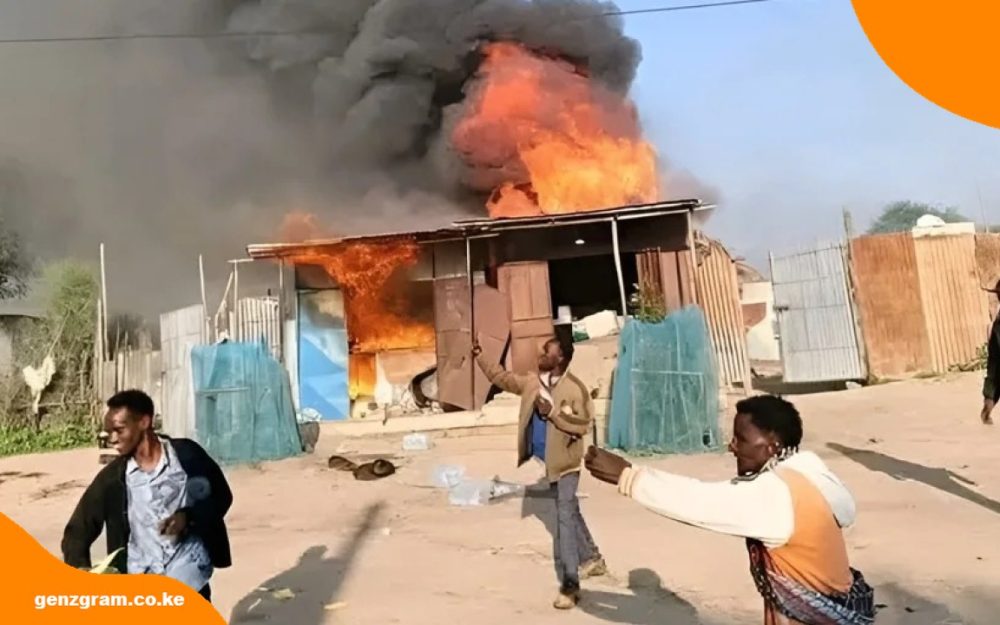
Hundreds of Ethiopians have crossed into Kenya after violence erupted in the border town of Moyale, prompting the Kenya Red Cross Society to launch an emergency humanitarian operation targeting approximately 1,000 households.
The displaced families, many of them women, children and young people, began arriving on the Kenyan side of the border on Wednesday, October 21, 2026, as fighting and gunfire were reported across the frontier in Ethiopia.
The Kenya Red Cross has begun arranging temporary shelters and distributing essential supplies to families who fled their homes with few belongings. The relief operation is being conducted in collaboration with the Marsabit County Government, national authorities and humanitarian partners.
According to Reuters, gunfire could still be heard on the Ethiopian side on Thursday, October 22, while Kenyan authorities maintained heightened security in Moyale.
The situation has raised concerns about the safety of civilians caught up in the violence and the growing humanitarian needs of those seeking refuge in Kenya.
Kenya Red Cross steps in to assist displaced families
The Kenya Red Cross Society said its initial response would reach approximately 1,000 households affected by the cross-border insecurity.
The organisation is distributing tents, blankets, sleeping mats, jerrycans and kitchen sets to help families meet their immediate needs. It is also providing fortified porridge flour, commonly known as Super Cereal, to support young children, pregnant women and breastfeeding mothers.
First-aid services are being offered to people requiring immediate medical attention, while teams conduct assessments to establish the most urgent needs among the arriving families.
Many of those fleeing reportedly arrived with very few possessions, leaving them dependent on relatives, local residents and humanitarian assistance for basic necessities.
Kenya Red Cross Secretary General Ahmed Idris said the organisation’s priority was to ensure that families arriving in Moyale were safe, sheltered and treated with dignity. The agency has pledged to continue responding as the needs of displaced people become clearer.
The assessment is expected to guide decisions on additional assistance, including food, clean water, sanitation, healthcare and protection for vulnerable groups.
Gunfire reported as families cross the border
The violence has affected communities around Moyale, a town divided by the international boundary between Kenya and Ethiopia.
Kenyan authorities reported that people began crossing into Kenya on Wednesday night through several entry points, including Sessi, Kore, Biashara, Foundation and Miti.
Marsabit County Commissioner Stanley Kamande told Reuters that hundreds of Ethiopians, mainly women and children, had entered Kenya. Many were staying with relatives and well-wishers in villages on the Kenyan side.
Although the Kenyan side of Moyale remained generally calm, security concerns increased after several incidents involving stray bullets were reported.
According to an Associated Press report citing Kenyan police, a woman in Moyale was injured by a bullet that struck her neck. She was taken to a private hospital, where the bullet was removed, and was reported to be in stable condition. A bullet also reportedly struck a metal support bar at the Moyale police station’s football ground, while another shattered a hotel window.
Police did not identify the source of the gunfire in the reported incidents.
The developments underline the risks facing communities living close to the border, where violence on one side can have immediate consequences for people on the other.
What triggered the fighting in Ethiopia?
The precise circumstances behind the latest clashes were not immediately clear in the initial Reuters reporting.
Other media reports have linked the tensions to a dispute involving Ethiopia’s Oromia and Somali regional states, with accounts pointing to disagreements surrounding the raising of a regional flag. However, the full sequence of events and the circumstances that led to the fighting require further confirmation from the relevant authorities.
The clashes are taking place in southern Ethiopia and should not automatically be conflated with the separate conflict in the country’s northern Tigray region.
The lack of a complete official account has made it difficult to establish the full scale of the violence, the number of people displaced within Ethiopia and whether further cross-border movements should be expected.
For families leaving affected areas, however, the immediate priority is safety rather than the political or administrative disagreements behind the fighting.
Humanitarian needs grow in Moyale
The arrival of displaced families is placing additional pressure on local communities and humanitarian responders in Marsabit County.
People who flee suddenly often leave behind food stocks, household possessions and sources of income. Without adequate shelter, clean water and sanitation, displaced families can face further difficulties, particularly when children and other vulnerable people are involved.
The Kenya Red Cross is assessing needs to determine which forms of support are most urgent. Its response includes household supplies, nutritional assistance, first aid and efforts to reconnect relatives who may have become separated during the displacement.
County and national authorities are also expected to coordinate further humanitarian assistance as the situation develops.
The initial target of 1,000 households reflects the planned reach of the Red Cross operation; it should not be interpreted as a final count of all those displaced. The total number of people who have crossed into Kenya, as well as the number displaced within Ethiopia, remained uncertain in the initial reports.
Security and the next steps
Kenyan authorities have maintained heightened vigilance in Moyale amid reports of continued gunfire across the border. The immediate challenge is to protect civilians, manage the arrival of displaced people and prevent the insecurity from spilling further into Kenyan territory.
Humanitarian organisations will also need to monitor the availability of shelter, food, water and medical services as they establish the scale of displacement.
For residents of Moyale and surrounding communities, the coming days will be important in determining whether the violence subsides or further families seek safety in Kenya.
The Kenya Red Cross has indicated that its response will evolve as assessments identify additional needs. Further information from Ethiopian authorities and security agencies will be important in clarifying the cause of the clashes and the outlook for communities affected by the violence.
For now, the immediate focus remains on assisting families who have crossed the border and ensuring that vulnerable people receive protection and essential supplies.