France has been rocked by widespread unrest after demonstrations against the rising cost of living escalated into violent clashes, with vehicles set ablaze, businesses looted and public buildings attacked in several cities.
The protests, which took place on Saturday, October 17, 2026, brought hundreds of thousands of people onto the streets to express frustration over rising prices, declining purchasing power and concerns about deteriorating public services. What began largely as peaceful demonstrations later descended into violence in several locations, prompting police to deploy tear gas and water cannons to disperse unruly crowds.
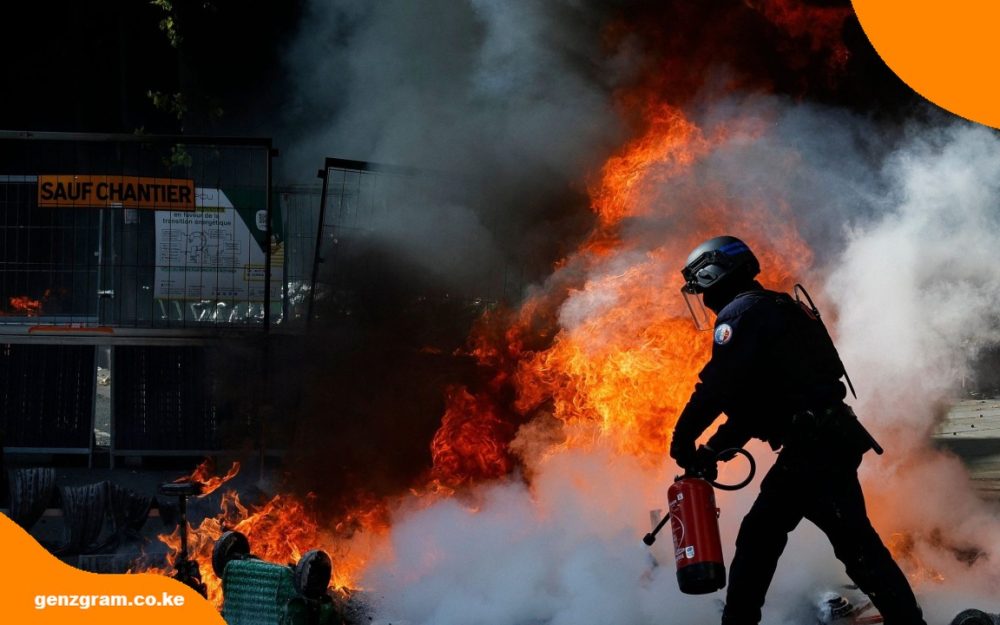
The unrest affected major urban centres, including Paris, Lyon, Marseille and Limoges. Images from the demonstrations showed burning vehicles, smoke rising above city streets and damaged commercial premises as emergency services responded to incidents across the country.
The demonstrations have renewed debate about economic hardship in France and the growing frustration among sections of the population over the cost of everyday necessities.
Cars torched as businesses are looted
Paris was among the cities affected by the violence, with masked individuals setting vehicles on fire and looting shops as clashes broke out around the Place de la République and other parts of the capital.
Police used tear gas against groups throwing projectiles and fireworks at officers. Several shops were reportedly ransacked, while fires involving vehicles and other street objects added to the disruption.
The violence was not confined to Paris. In Lyon, a tourist office was looted and set on fire during clashes around Place Bellecour. In Marseille, demonstrators forced their way into the city hall lobby, damaging parts of the building and leaving graffiti before police intervened.
Limoges also experienced serious damage after its city hall was set ablaze. The incidents highlighted how violence by some groups overshadowed the wider demonstrations, which included thousands of people protesting peacefully.
According to the Associated Press, authorities reported hundreds of arrests during the initial response. Subsequent reports from French officials described a substantially higher arrest total as the scale of the unrest became clearer.
Although the destruction was extensive in some locations, available reporting does not establish that every person involved in the demonstrations participated in violence. Many demonstrators attended to express economic and social grievances without engaging in criminal acts.
What triggered the demonstrations?
The protests were driven by several grievances, including rising living costs, fuel prices, declining purchasing power and dissatisfaction with public services.
Food, transport, energy and housing expenses have become central concerns for households struggling to maintain their standard of living. Protesters demanded action to ease financial pressure and improve the conditions affecting workers, students and other groups.
The demonstrations also brought together people concerned about education. High school students had staged protests in the preceding weeks over conditions in schools and the resources available to educational institutions.
Trade unionists, students, farmers, climate activists and supporters of France’s Yellow Vest movement were among the diverse groups associated with the mobilisation. The revival of Yellow Vest activism is particularly significant because that movement first became nationally prominent in 2018, when protests against fuel taxes and economic inequality developed into a broader challenge over purchasing power and government policy.
The latest protests therefore reflect more than one isolated complaint. They have become a meeting point for different groups expressing frustration about household expenses, public spending priorities and the government’s response to social concerns.
How many people took part?
Estimates of attendance differed between government officials and organisers.
The French Interior Ministry reported approximately 550,000 participants nationwide, while the CGT trade union put the figure at around 800,000. The demonstrations included roughly 110 separate marches across the country, according to reporting by international news agencies.
The difference between the estimates reflects the contrasting methods and perspectives used to assess the size of large public gatherings.
Despite the disagreement over numbers, the turnout demonstrated the capacity of economic and social grievances to mobilise people across different parts of France.
However, the large attendance should not be interpreted as evidence that every participant supported the violent acts that occurred alongside the marches. Many people were there to exercise their right to peaceful protest and call for changes to economic and public-service policies.
French authorities condemn the violence
The unrest has placed pressure on French authorities to restore order while responding to the concerns raised by demonstrators.
President Emmanuel Macron called for respect for people and property, while Prime Minister Sébastien Lecornu condemned the violence and indicated that those responsible for criminal acts would face legal consequences.
Authorities have drawn a distinction between peaceful demonstrations, which are protected under democratic principles, and acts such as arson, looting and attacks on police officers or public buildings.
The destruction has also raised concerns about the financial burden placed on businesses, municipalities and taxpayers. Damaged buildings must be repaired, looted businesses may lose income, and emergency services must devote resources to responding to fires and disorder.
At the same time, the handling of demonstrations and the use of crowd-control measures have attracted scrutiny. Reporting from the protests included accounts of injuries, highlighting the risks faced by demonstrators, police officers and bystanders when confrontations become violent.
A wider warning about economic frustration
The events in France illustrate how cost-of-living concerns can intersect with dissatisfaction over education, public services and government priorities.
France has a long history of mass demonstrations, and public protest remains an important feature of its political culture. Nevertheless, the latest incidents demonstrate the difficulties authorities face when large peaceful gatherings are accompanied by groups engaging in destruction and clashes with police.
For ordinary residents and business owners, the immediate consequences include damaged property, disrupted transport, lost trading opportunities and concerns about personal safety.
The protests also raise questions about what measures the government can take to address public frustration over prices and purchasing power while maintaining public order.
As investigations into the violence continue, the distinction between peaceful demonstrators and those responsible for criminal acts will remain important. The grievances that brought people onto the streets will also require political and economic responses if authorities hope to ease tensions.
For now, France is confronting two connected challenges: restoring order in areas affected by the unrest and addressing the underlying concerns over living costs and public services that helped drive the demonstrations.
Follow Our WhatsApp Channel for Daily Real-Time News Updates