
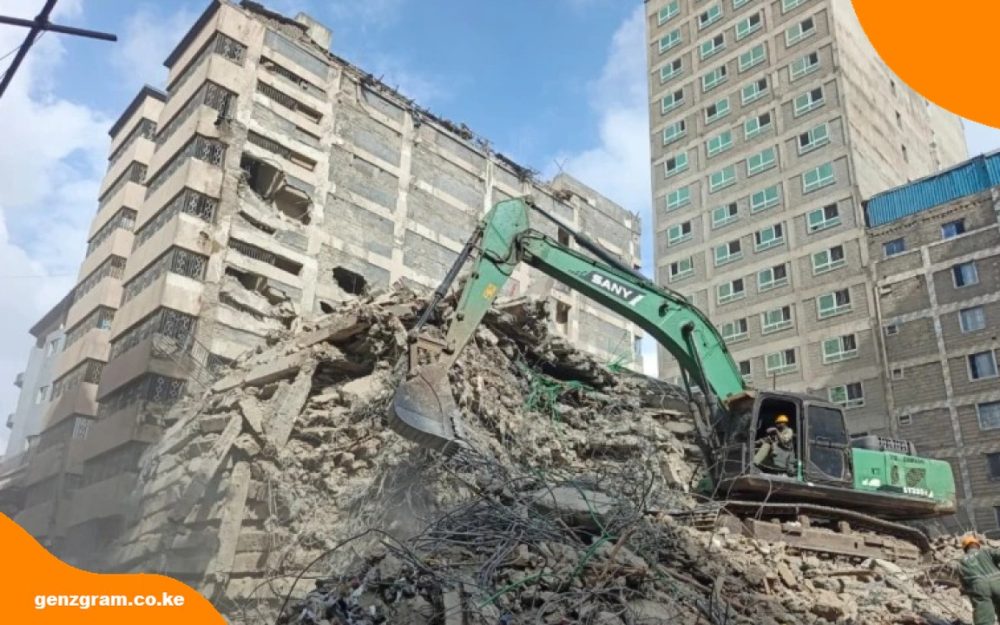
Search and rescue operations continued in Nairobi’s Eastleigh area on Saturday, October 24, after a multi-storey building under construction collapsed, leaving seven people reported missing and raising renewed questions about the enforcement of building safety regulations in Kenya.
The building came down along 9th Street on Friday afternoon, October 23, in a densely populated commercial neighbourhood where businesses and construction activities operate close to residential buildings.
Interior Cabinet Secretary Kipchumba Murkomen said 67 construction workers had been at the site when the building collapsed. According to the government’s update, 66 escaped without injuries, while one worker was injured and taken to hospital.
However, the search continued for seven people believed to have been inside shops located on the building’s ground floor and basement when the structure collapsed. Authorities said rescuers had established contact with some of those reported missing, although efforts to locate and reach them were still underway.
The operation brought together multiple agencies, including the Kenya Defence Forces, National Police Service, Nairobi City County Government, National Youth Service and Kenya Red Cross. Rescue teams continued clearing debris while trying to reach people who might still be trapped beneath the rubble.
Residents’ accounts highlight the human cost
For people who work and live around Eastleigh, the collapse turned an ordinary Friday afternoon into a scene of confusion and fear.
Witnesses described the building coming down around 1 p.m., sending debris and dust into the surrounding area. Families and acquaintances began trying to contact people who might have been inside, while emergency responders worked to establish the extent of the disaster.
The Associated Press reported that some residents received calls from loved ones believed to be trapped beneath the rubble, but later struggled to reach them again. The rescue effort also faced challenges because the collapsed structure was surrounded by other high-rise buildings, restricting access to parts of the site.
Such accounts illustrate the uncertainty faced by families waiting for information about missing relatives. They also underline why rescue operations must be conducted carefully, balancing the urgency of reaching potential survivors against the danger of further destabilising the debris.
At the time of publication, the seven missing people had not all been accounted for in the available official updates. The final number of casualties and the circumstances of those still missing remained uncertain.
Who is responsible for building safety in Nairobi?
Beyond the immediate rescue operation, the collapse has renewed an important public question: who is responsible for ensuring that buildings in Nairobi are safe?
Building safety is not the responsibility of one individual or institution. It involves developers, contractors, architects, structural engineers, county planning and enforcement departments, and national regulatory bodies. Each has a distinct role in ensuring that structures are designed, approved, constructed and inspected according to applicable standards.
Nairobi City County is responsible for development control and planning enforcement within the county. Its built-environment sector includes urban development control, planning compliance and enforcement, and building-related functions. These responsibilities make county oversight an important part of preventing unsafe construction.
The National Construction Authority (NCA), established under the National Construction Authority Act, regulates the construction industry and oversees the registration and monitoring of construction projects. The law also provides for mandatory inspections of construction sites.
Meanwhile, the National Buildings Inspectorate, under the State Department for Public Works, undertakes building inspections and audits, assesses structural safety and can recommend enforcement measures where structures are found to be unsafe.
These institutions have complementary responsibilities. County approval alone does not remove the need for proper construction practices, qualified professionals, appropriate materials and effective inspections throughout a project.
Approval is not the same as safety
One of the central questions in any building collapse is whether the structure complied with the approved plans and relevant construction standards.
An approved building design is an important safeguard, but approval is only one stage in the construction process. The work on the ground must follow the approved design, and qualified professionals must ensure that structural elements are properly executed.
Investigators may need to examine the foundation, structural design, construction materials, reinforcement, workmanship, site supervision and whether the building was altered from its approved plans. They may also need to establish whether inspections took place at the required stages and whether any safety concerns had previously been raised.
In this case, it would be premature to identify a specific technical failure or accuse a particular person of negligence before the investigation is complete.
The collapse itself, however, makes a thorough and transparent investigation essential. Authorities must establish not only what caused the structure to fail, but also whether any regulatory or professional safeguards were ignored.
Nairobi Governor calls for tougher enforcement
Nairobi Governor Johnson Sakaja visited the scene and called for tougher action against developers who violate construction regulations. Reports also indicated that he questioned whether existing penalties were sufficient to deter non-compliance.
The incident has renewed calls for stronger enforcement, meaningful consequences for proven violations and clearer accountability across the construction sector.
However, accountability must be based on evidence. Investigators should establish the roles played by the developer, contractor, relevant professionals and oversight agencies before determining whether any individual or institution bears legal responsibility.
A credible investigation should explain the building’s approval history, the inspections conducted, the applicable safety requirements and any failures identified. Its findings should lead to appropriate legal or regulatory action where wrongdoing is established.
Preventing another building disaster
Kenya’s growing urban population has increased demand for residential and commercial buildings. In areas such as Eastleigh, where businesses, residents and construction sites occupy limited space, a structural failure can expose many people to danger.
Preventing future collapses requires more than issuing warnings after a disaster. It calls for consistent inspections, qualified construction professionals, reliable building materials, proper site supervision and enforcement that applies regardless of a developer’s financial or political influence.
Residents also have a role in reporting visibly dangerous structures or construction activities to the relevant authorities. The Architectural Association of Kenya’s Mulika Mjengo initiative, for example, provides a public reporting channel for concerns about unsafe buildings and potentially illegal construction in Nairobi.
The authorities must ensure that such reports receive timely technical assessment and, where necessary, enforcement action.
For now, the priority remains finding the missing people and supporting affected families. Once the rescue operation permits, the investigation must provide clear answers about the circumstances surrounding the collapse.
The question facing Nairobi is not simply why one building fell, but whether the systems designed to prevent such disasters are working effectively. The lives of residents, workers, traders and passers-by depend on building safety rules being enforced before tragedy strikes, rather than only being discussed afterwards.